Business to Business Shopping
 Order With Your Net 30 Account
 Ship On Your UPS or FedEx Account
 Easy Reordering, Stocking Programs
Sometimes we think of fanfold labels as an old-fashioned approach — we remember those reams of green and white fanfold paper rolling off early computers — but, the fact is that fanfold labels offer a number of advantages over rolls that companies should consider as they seek an edge in today’s competition.
Make Your Business More Competitive with Fanfold Labels
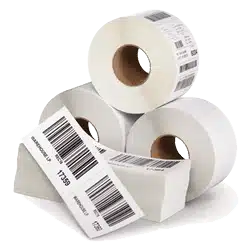
Continuous fanfold thermal transfer or fanfold direct thermal labels can come in stacks and lie flat, or they can come in rolls. Three major advantages other than price factor come into play when you consider using flat fanfold labels:
- The flat fanfold label stacks can save more space than the more common roll of barcode thermal labels.
- If you’re using thicker stock, the cardstock fanfold stationery is definitely preferable, because fanfold flat labels stay flat.
- Fanfold labels come in standard sizes, which makes your options easier on the front end when designing your labels.
How You Save Money with Fanfold Labels
While smaller runs that don’t use thick stock may not pan out penny-for-penny with fanfold flat labels vs. rolls, instances do exist where you can save a substantial sum over time by using fanfold labels.
Fewer reloads, especially on longer runs - The compatible thermal printer can hold a larger amount of continuous labels in fanfold stacks rather than running label rolls, so you definitely save time on less frequent roll changes during high-volume applications. A typical 4” x 6” fanfold label stack has twice the numbers labels of an 8” roll. This accounting means that your runs are longer and more efficient while cutting annual reloads by half.
No need to pay for someone to attend printing -- Large runs of thermal roll labels usually calls for an attendant to stand at the front of the printer to stack labels by hand as the labels print. Fanfold labels eliminates the cost of that assistant (or helps to reallocate that labor), as the labels are self-stacking.
Less waste means more money in your pocket -- Fanfold labels are packed more compactly than rolls, and fit better into rectangular packaging. They’re easier to store, handle, and ship than their rolled counterparts. Further, the need for less frequent carton replacement drives down cost and waste. Finally, fanfold labels don’t require rolls, so you can save money on those items as well as wear and tear and replacements.
The bottom line for large label runs in a business environment is to look to the past. Fanfold labels may be the resource you need to do more with less and to control expenses for competitive advantage. If you’d like to explore how this transition might help your company, we’d love to talk to you. You can reach us here.